
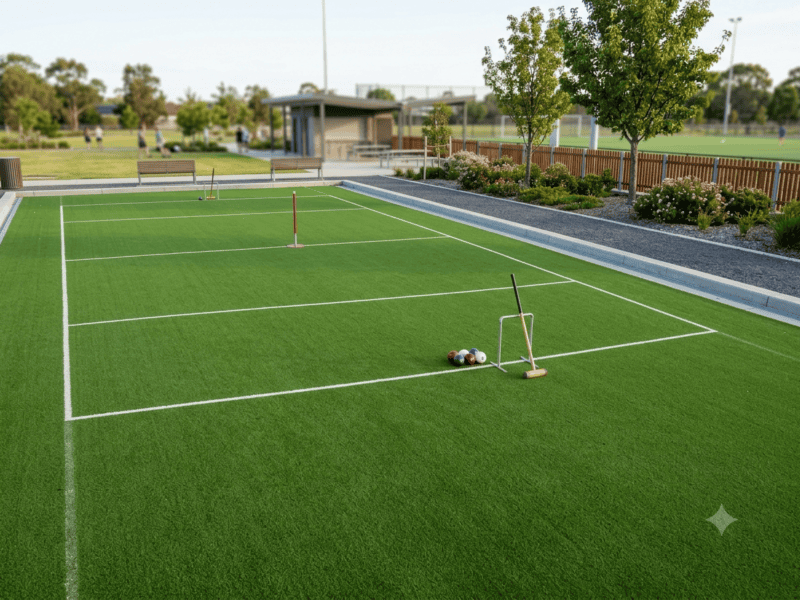
When investing in a premium gateball facility, most buyers focus heavily on selecting the right artificial grass fiber, density, and pile height. However, as a veteran artificial turf manufacturer, we always remind our clients that a world-class court is only as good as the ground beneath it.
The longevity, safety, and performance of the playing surface are deeply rooted in the structural integrity of its foundation. Even the most advanced synthetic turf will fail prematurely if installed on a poorly engineered base. To ensure your project meets professional sporting standards, here is a comprehensive guide to the critical sub-base specifications required for artificial turf gateball courts.
1. Surface Levelness & Flatness Specifications
Achieving absolute surface precision is critical for gateball, a sport that relies entirely on predictable ball rolling, strict trajectories, and strategic positioning.
- The 95% Qualification Rule: The overall flatness qualification rate of the civil sub-base must exceed 95%.
- Strict Tolerances: When tested using a professional 5-meter straightedge, the maximum allowable surface deviation must be kept within 3mm.
Why this matters to manufacturers: Ensuring an ultra-flat foundation guarantees that when our artificial turf is rolled out, it maintains a completely uniform thickness and consistent shock absorption across the entire facility. This eliminates irregular ball bounces and significantly reduces player injury risks caused by hidden surface depressions.
2. Engineered Slopes for Rapid Drainage
Effective water management protects the backing of your synthetic turf from premature degradation and prevents hazardous surface hydroplaning. Gateball court sub-bases implement a specialized multi-slope scheme, often employing a convex “turtle-back” design to guide water efficiently toward external drainage channels:
| Court Zone / Section | Standard Slope Gradient | Design Objective |
| Central Playing Area | 0.3% – 0.4% | Convex turtle-back shedding to avoid central ponding |
| Straight Tracks (Straightaways) | 0.5% | Linear runoff guidance toward perimeter channels |
| Semi-Circular Areas | 0.5% | Maintains consistent planar smoothness |
| Curved Sections (Bends) | 0.8% | Accelerated drainage for high-velocity outer runoff |
3. Structural Load-Bearing & Compaction Density
The sub-base must possess superior structural strength and long-term stabilization properties. It must seamlessly support the combined weight of the premium synthetic grass layers, heavy infill materials (such as silica sand and performance rubber granules), continuous foot traffic, and seasonal freeze-thaw climate cycles.
- Compaction Density: The compaction rate of the sub-base cushioning layers must exceed 95% under heavy roller testing to eliminate localized shifting or future soil settling.
- Surface Integrity: The finished foundation surface must be uniform, dense, and entirely free from structural cracks, crumbling edges, or loose honeycomb textures. All construction joints must be aligned, level, and smoothly finished.
4. Specialized Moisture-Proof Barriers
Capillary action can force underground moisture upward, which threatens the stability of the foundation and can weaken the specialty adhesives holding the turf seams together. To prevent this, a high-performance moisture barrier is integrated directly above the compacted layer.
We mandate the installation of a heavy-duty, brand-new PVC thickened waterproof membrane. During installation, the overlapping seams between adjacent membrane sheets must be no less than 200mm to 300mm. Additionally, a structural margin allowance exceeding 150mm must be maintained at all outer boundaries to form an impenetrable shield against subterranean vapor transmission.
Pro Manufacturer Tip on Expansion Joints: During the civil pouring phase, structural expansion joints must be pre-cut at a width of approximately 5mm. This naturally accommodates subtle thermal expansion and contraction cycles without causing the surface to heave or warp.
5. Curing & Stabilization Timeline
Patience during the civil construction phase directly impacts the lifespan of the sports facility. Once the concrete or asphalt base pouring is complete, the foundation must undergo a rigorous curing phase before any synthetic turf installation can begin.
The standard stabilization period spans from 21 to 28 days. This timeline fluctuates slightly based on regional humidity, ambient temperatures, and specific concrete mix designs. Allowing the base to fully cure ensures maximum chemical hydration and structural crystallization, giving the foundation its ultimate load-bearing capacity.
6. Pre-Installation Cleanliness & Turf Seaming
Before unrolling the artificial turf, the cured foundation must be meticulously cleared of all debris, dust, oil stains, and loose stones.
During layout, the artificial grass panels should be securely joined using specialized high-tensile jointing tapes and commercial-grade polyurethane adhesives. Seams must be tightly aligned and weighted down to eliminate any visible gaps, ensuring a seamless, monolithic playing surface.
Finally, the overall perimeter drainage infrastructure must be perfectly synchronized with the court slopes. A professionally engineered system should ensure that even after heavy rainstorms, the entire court can completely clear surface water within two hours, returning the facility to a dry, safe playable state.
Conclusion
Building a professional gateball court is a symbiotic process where the sub-base and the artificial turf must work in harmony. By strictly adhering to these standards for flatness, slope, compaction, and moisture proofing, you safeguard your investment and guarantee a high-performance field that lasts for years.
As a dedicated artificial grass manufacturer, we provide not only premium turf systems engineered for sports dynamics but also full technical support to ensure your ground preparation is flawless. Contact our engineering team today for customized court layouts and specifications!