
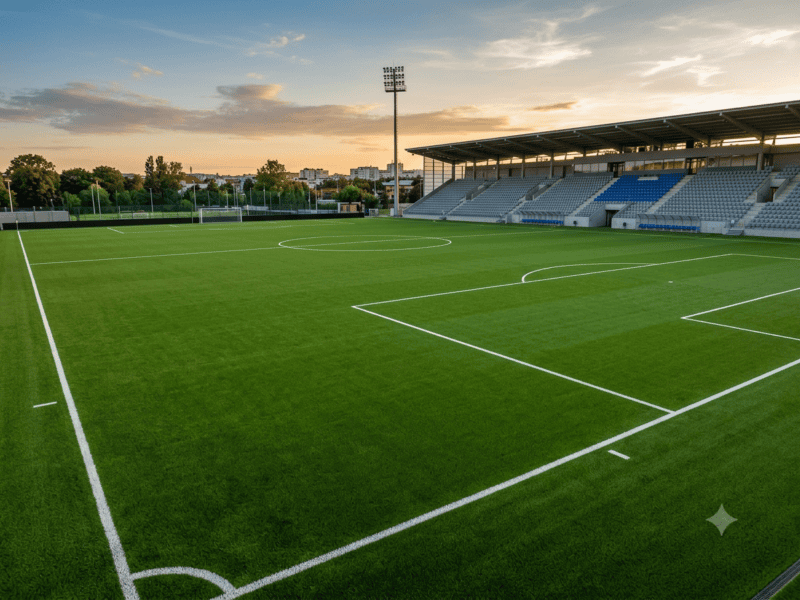
For football clubs, stadiums, and training facilities, selecting the right pitch is one of the most critical investments they will ever make. A high-quality artificial turf does more than just look good—它 directly impacts player safety, ball behavior, and long-term operational costs.
As a dedicated artificial grass manufacturer, we understand that navigating the technical specifications of sports turf can be daunting. To help you make an informed decision, we have broken down the essential factors football clubs must evaluate to find the perfect balance of performance, durability, and cost-effectiveness.
1. Turf Specifications and Performance Metrics
The foundation of any world-class football pitch lies in the technical build of the synthetic grass itself. When auditing suppliers, clubs should focus on five core metrics:
- Pile Height: For standard and professional football pitches, FIFA-certified standards generally require a pile height between 50mm and 65mm. This specific range delivers optimal ball roll, realistic bounce, and maximum comfort for the players’ joints.
- Yarn Material: We highly recommend Polyethylene (PE) for football applications. While Polypropylene (PP) exists on the market, PE yarn offers superior softness, excellent wear resistance, and the resilience needed to withstand heavy, cleat-heavy foot traffic.
- Turf Density: A premium football pitch requires a dense stitch rate, typically ranging from 9,500 to 10,500 stitches per square meter. Higher density translates to better foot traction and a more natural playing experience.
- Wear Resistance: A pitch’s lifespan depends entirely on its durability. Clubs must choose high-grade polymers that match their facility’s usage frequency to prevent premature thinning of the turf.
- UV Stability: Since outdoor pitches face relentless sun exposure, ensuring the turf has advanced UV-inhibitors built into the yarn is vital. This prevents fading, brittle fibers, and premature degradation.
2. The Science of Infill Materials
What goes between the blades of grass is just as important as the blades themselves. The infill system provides the ballast and shock absorption that mimics real soil.
- Quartz Sand: Acting as the stabilizing weight, quartz sand keeps the turf blades upright and prevents the backing from shifting. The ideal grain size is 0.3 to 1.5mm, with a silica content above 90%. Clubs should expect an infill rate of 20 to 30 kg per square meter.
- Rubber Granules (SBR/TPE): To protect athletes from impact injuries, rubber granules are added for cushioning. With a standard grain size of 1mm to 3mm, a typical professional pitch requires approximately 5 to 8 kg per square meter to achieve the right shock absorption and energy restitution.
3. Vetting the Manufacturer and Quality Control
Not all artificial turf is created equal. Partnering with an experienced manufacturer ensures you receive a product built to international standards. Before placing a bulk order, clubs should request samples and perform these quick quality checks:
- Pull Test: Test the tuft bind strength to ensure the blades won’t easily pull away from the backing during intense matches.
- Tactile Feel: Touch the yarn to evaluate its softness and flexibility. It should feel resilient, not stiff or abrasive.
- Backing & Coating Inspection: Examine the primary and secondary backing (typically polyurethane or latex). A high-quality coating ensures the turf remains dimensionally stable under extreme weather conditions.
4. Balancing Facility Needs and Budgetary Constraints
Every club has unique requirements. A stadium hosting professional, televised league matches will require top-tier, FIFA-quality turf systems. Conversely, a community training academy might prioritize maximum durability and cost-efficiency.
As a factory-direct manufacturer, we always advise clubs to look at the Total Cost of Ownership (TCO). While premium turf carries a higher upfront cost, its extended lifespan and lower replacement frequency offer a much higher return on investment (ROI) over time.
5. Post-Installation Maintenance and Longevity
While synthetic turf requires significantly less upkeep than natural grass, it is not entirely “maintenance-free.” To keep the pitch in peak condition:
- Routine Cleaning: Regularly clearing debris, leaves, and surface dirt prevents the infill from compacting and maintains proper drainage.
- Professional Deep Maintenance: For high-traffic club pitches, scheduling periodic professional maintenance—such as de-compacting the infill, brushing the fibers, and checking seams—is highly recommended to extend the pitch’s lifespan up to 8–10 years.
Conclusion
Choosing the right artificial turf is a strategic decision that shapes the future of a football club. By carefully evaluating turf specifications, infill quality, manufacturer credentials, and long-term maintenance, clubs can create a safe, high-performance environment where players can thrive.
Looking for the perfect turf for your next football project? As a leading artificial grass manufacturer, we provide tailor-made, high-performance sports turf solutions directly from our factory to your venue. [Contact our engineering team today] for free samples and expert consultation!