
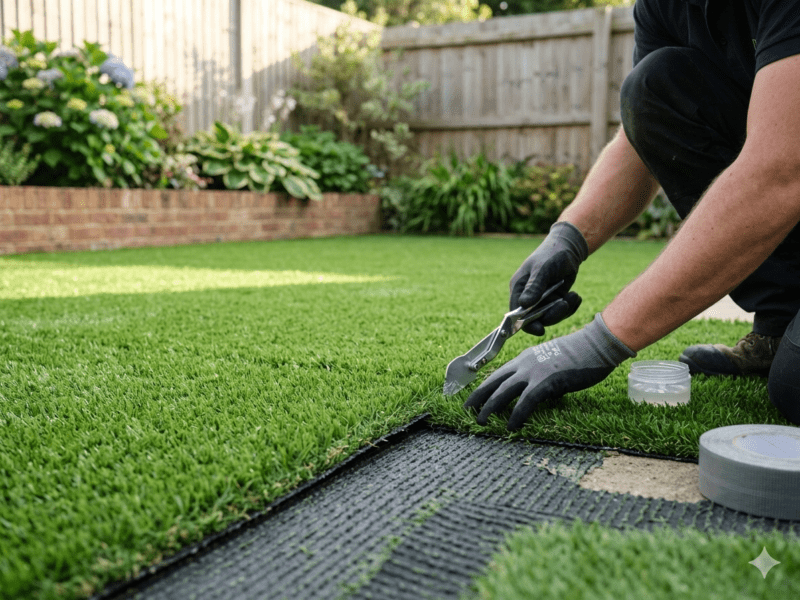
Artificial grass is widely loved for a simple reason: it’s incredibly tough and requires barely any work to look great. However, no matter how premium the quality is, years of heavy foot traffic, playful pets, shifting garden furniture, or accidental scrapes from sharp tools can eventually take a toll.
When a section of turf gets damaged, many property owners automatically assume they need to rip the whole thing out and start over. But as an artificial grass manufacturer, we always tell our clients the exact opposite. Complete replacement is expensive, time-consuming, and honestly, a huge waste of perfectly good material.
Most localized turf issues can be completely restored with a few clever, budget-friendly fixes. Here is our step-by-step guide to tackling the four most common artificial grass problems like a pro.
1. Fixing Damaged Grass Blades (Matting & Shedding)
Daily foot traffic or leaving heavy items in one spot can cause your turf blades to flatten out (matting), split, or even pull loose entirely.
- For Light Matting: You don’t need any glue or patches for this. Just grab a stiff-bristled broom or a specialized turf rake and brush vigorously against the grain. The fibers will stand right back up in no time.
- For Split or Frayed Blades: If you notice just a few random loose ends sticking up, simply snip them flat with sharp scissors. This stops them from catching on shoes or paws and ripping further.
- For Major Shedding (Bare Patches): If a small patch of grass has completely pulled away, you can patch it. Clean the backing area, apply a high-quality, weather-resistant turf adhesive, and insert matching replacement blades (it’s always a good idea to save off-cuts from your initial installation for this). Press down firmly and let it cure.
2. How to Repair Separated or Splitting Seams
Seams coming apart is probably the most frequent headache we hear about. This usually happens because of weak glue application during installation, ground shifting underneath, or constant pulling from high-traffic usage. You will notice the edges where two turf rolls meet starting to lift or curl up.
The Fix: First, gently pull back the loose edges and clear away any dirt, dried old glue, or debris from underneath. The area must be completely dry before you proceed. Apply a fresh layer of specialized artificial turf seam glue onto the jointing tape. Carefully line up both sides of the turf—make sure no grass blades get trapped in the glue—and press down hard.
To ensure a permanent bond, place some heavy objects (like bricks or sandbags) along the seam and leave them there for at least 24 hours. If the jointing tape underneath is torn or badly degraded, make sure to slip a new piece of tape underneath before regluing.
3. Patching Backing Damage & Restoring Infill
The backing cloth is the backbone of your artificial turf. Heavy equipment, sharp garden tools, or burrowing pests can sometimes puncture or tear it. If left ignored, a small tear will quickly lead to massive grass loss and ruin the sub-base structure.
- For Small Punctures: Clean the area and apply a generous amount of turf adhesive directly into and over the tear to seal it back up.
- For Severe Tears (The “Surgical” Patch): You will need to cut out the damaged section cleanly. Next, cut a piece of matching backing material that is about 5 to 10 cm larger than the hole on all sides. Slip this new piece underneath the original backing to create a solid overlap. Apply your adhesive, press down firmly, and then patch in new grass fibers on top so it blends seamlessly with the rest of your lawn.
Don’t forget the infill: If the damage caused you to lose some of your infill (like silica sand or rubber granules), remember to top it up in that specific area. Infill keeps the grass resilient and cushions the backing against premature wear.
4. Golden Rules for Long-Lasting Turf Repairs
Successful DIY turf repair really comes down to three things: catching it early, using the right tools, and giving it time to heal.
- Do regular check-ups: Walk your lawn every few months, paying close attention to the seams and high-traffic pathways. Fixing a 5 cm loose seam is a 10-minute job; fixing a 5-meter ripped seam is a nightmare.
- Let it cure: After applying any adhesive, keep kids, pets, and heavy traffic off that section for 24 to 48 hours. Keep it completely dry until the glue sets.
Looking for Premium, Durable Turf?
Knowing how to fix your grass saves you big money and extends your lawn’s lifespan by years. However, the best defense against damage is starting with high-quality materials.
As a leading artificial grass manufacturer, we engineer our turf with multi-layer backing and UV-stabilized fibers to handle the toughest weather and heaviest use. Whether you are a distributor looking for reliable stock or a contractor needing factory-direct pricing, [Contact Us Today] to get free samples and quotes!