
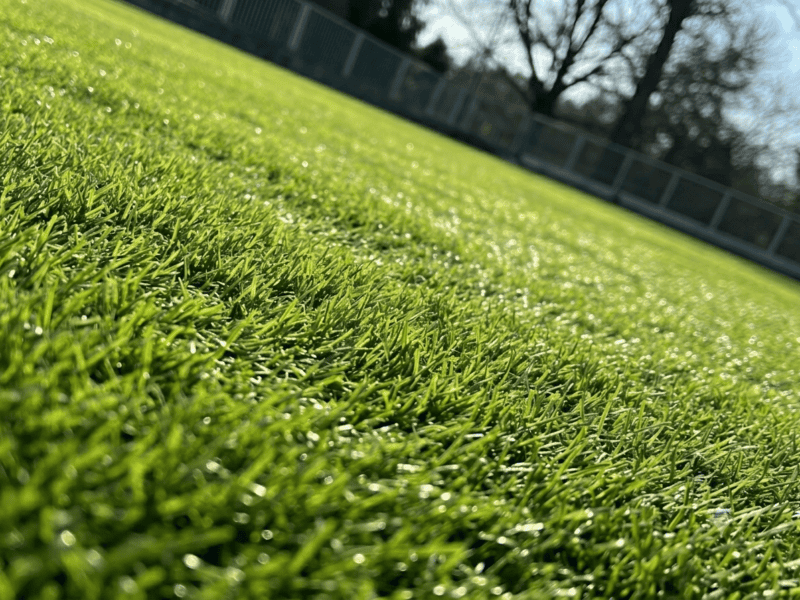
The global surge in artificial turf adoption across sports arenas, commercial landscapes, and residential projects is backed by an intricate network of engineering. Among these components, the drainage system acts as an “invisible guardian.” Often overlooked during initial design phases, its efficacy directly governs the longevity and structural integrity of the entire installation. For regions experiencing high precipitation, implementing a scientifically sound, premium-tier drainage system is not just a recommendation—it is a critical prerequisite for commercial success and product durability.
1. The Hidden Costs of Poor Drainage: Accelerated Degradation
When synthetic turf fields or lawns suffer from inadequate drainage, the consequences extend far beyond superficial aesthetic issues. Standing water generates severe structural risks that threaten B2B project investments and commercial landscaping:
- Fiber Flattening & Matting: Prolonged water accumulation causes synthetic grass blades to lose their vertical resilience, leading to premature flattening and severe pile matting. This permanently degrades the turf’s natural visual appeal and tactile performance.
- Backing Delamination & Adhesive Failure: Water seeping into the interface between the primary backing and the sub-base foundation gradually degrades the chemical adhesives. Over time, this moisture exposure leads to edge curling, seam splitting, and severe backing delamination.
- Microbial Proliferation & Health Hazards: Stagnant moisture turns the infill and turf backing into a breeding ground for mold, mildew, and harmful bacteria. This creates foul odors and introduces biohazards to public or sports environments.
- Athletic Injury Risks: For sports pitches, improper water dispersion yields muddy, slick surfaces that compromise traction, accelerating player slippage, joint sprains, and structural injuries during high-intensity games.
Factory Insight: As a dedicated global manufacturer of high-density artificial turf, we intentionally engineer our multi-layer backings with high tensile strength to resist hydro-exposure. However, an optimized underlying drainage foundation remains essential for the product’s structural survival.
2. Anatomy of a High-Efficiency Synthetic Turf Drainage System
An elite drainage mechanism requires a dual-layer approach, combining structural base filtration with top-tier turf permeability:
A. Sub-Base Drainage Layer (The Core Foundation)
The underlying foundation is the primary mechanism for moisture dispersion. A standard professional setup incorporates a 10cm to 20cm porous aggregate base—typically consisting of graded crushed stone, gravel, or expanded clay pebbles (ceramsite). This engineered stratum serves as a high-capacity water collection cushion, collecting surface water and directing it seamlessly into underground municipal pipe networks.
B. Turf Layer Permeability (Surface Dispersion)
Surface water relies entirely on the synthetic turf’s material properties. Premium artificial grass features a precise grid of drainage perforations (holes) punched through the backing, coupled with balanced tuft density. This design allows water to flow downward instantly, eliminating surface pooling.
C. Geometric Slope Configuration
For large-scale outdoor installations, relying on vertical filtration alone is insufficient. Engineers must integrate a precise 1% to 2% surface slope slanting toward perimeter catch basins or drainage swales to accelerate lateral water evacuation.
| System Layer | Material / Specification Standard | Primary Operational Function |
| Turf Layer | Perforated backing (approx. 10cm grid spacing), high-gauge pile. | Immediate vertical moisture passing; prevents surface water pooling. |
| Sub-Base Layer | 10-20cm compacted crushed stone (0-5mm to 10-20mm graded) or ceramsite. | High-capacity water collection and storage; channels water to sub-pipes. |
| Slope Gradient | 1.0% to 2.0% engineered inclination. | Lateral runoff direction toward external drainage mains. |
3. Precision Installation Practices: Eliminating Engineering Flaws
Translating an optimized design into real-world performance requires strict compliance during site construction. Every single step must be executed with technical precision:
- Pre-Construction Planning: Engineering teams must cross-reference local historical rainfall data with site topography to establish precise base depths and sub-drain configurations before delivering materials.
- Compaction & Pipe Integration: The stone aggregate must be compacted in gradual, uniform layers to prevent future localized subsidence. Perforated sub-surface drainage pipes must be precisely sloped and seamlessly coupled with the local stormwater network.
- Turf Deployment & Seaming Precision: Installers must confirm that the pre-punched drainage holes remain clear of sand or debris during roll layout. When applying polyurethane seam adhesives, technicians must apply the compound precisely across the jointing tape, ensuring no excess glue leaks over adjacent drainage holes.
- Post-Installation Flow Testing: Before handing over the project, teams must execute a comprehensive water-deluge test. This process involves simulating high-volume rain events to track absorption speeds and locate potential low-spot puddles for immediate correction.
4. Long-Term Maintenance & Retrofitting Aging Installations
Maintaining high drainage performance over a 10+ year product lifecycle requires consistent preventive care:
- Debris Management: Regularly sweep or blow organic debris, leaf litter, and airborne silt off the turf surface. If left unmanaged, these materials break down into fine particles and plug the backing perforations.
- Sub-Base Monitoring: Periodically inspect heavy-traffic zones for substrate shifting or sub-grade compaction. Any noticed indentation requires swift re-leveling to prevent standing pools.
- Pre-Monsoon Inspections: Before regional rainy seasons or heavy storms arrive, inspect all perimeter catch basins, drainage grates, and outflow pipes to clear accumulated blockages.
Retrofitting Solutions: For existing fields struggling with poor drainage due to historical construction flaws, full excavation is not always necessary. Specialist contractors can perform micro-punch retrofitting—adding specialized drainage channels or utilizing specialized aerators to perforate the base, restoring flow path viability without replacing the entire turf asset.