When selecting synthetic turf for commercial projects, residential landscaping, or athletic facilities, buyer evaluation often focuses on face weight and pile height. However, professional manufacturers recognize that flexibility stands as the primary technical metric determining tactile comfort, natural aesthetics, and long-term durability. Exceptional flexibility differentiates premium synthetic turf from rigid, lower-grade alternatives.
High-flexibility artificial turf mirrors the suppleness of natural grass underfoot. It dissipates impact energy, prevents skin abrasion, and enhances user safety across high-traffic installations—from commercial playgrounds to private lawns. Conversely, turf with deficient flexibility stiffens, becomes brittle under thermal exposure, and suffers premature fiber degradation. Achieving optimal flexibility requires precise chemical formulation across fibers, primary backings, and secondary coating matrices.
Core Manufacturer Insights
- Fiber Mechanics: Polyethylene (PE) polymers deliver superior elastic memory and tactile softness compared to PP or PA variants.
- Backing System Synergy: Dual PP woven fabric paired with non-woven fleece and flexible polyurethane (PU) backing preserves multi-directional bendability.
- Standard Compliance: Quality verification relies on ISO/GB standards measuring tensile elongation at break and flexural rigidity.
1. Polymer Selection and Fiber Engineering: The Core of Turf Suppleness
The intrinsic flexural modulus of synthetic turf relies heavily on raw polymer selection and extrusion parameters. Synthetic yarns exhibit distinct mechanical responses to compression, bending, and thermal fluctuations:
- Polyethylene (PE) Yarn: Represents the gold standard for high-flexibility applications. PE offers exceptional ductility and impact resilience. Extrusion refinement produces smooth molecular chain alignment, enabling rapid spring-back after mechanical load without permanent fiber deformation.
- Polypropylene (PP) Yarn: Demonstrates a higher flexural modulus, resulting in a firmer, rigid texture. PP yarn is primarily utilized as textured thatch layer support or in low-grade decorative installations where tactile softness is secondary.
- Polyamide (PA / Nylon) Yarn: Provides extreme tensile strength and thermal resistance, but lower flexural elasticity. Nylon fiber is typically integrated into specialized high-wear zones or high-density indoor putting greens.
Beyond material chemistry, physical blade architecture significantly impacts overall hand feel. Finer denier filaments, controlled yarn twist rates, and engineered cross-sectional profiles—such as C-shape, V-shape, or wave geometries—distribute mechanical stress evenly across the blade. This structural engineering achieves optimum upright resilience while maintaining a soft surface texture.
2. Backing Architecture and Polyurethane (PU) Coating Integration
Fiber performance alone cannot guarantee structural flexibility; the underlying backing system provides crucial mechanical support. A poorly engineered backing creates severe rigidity, leading to cracking during transport or roll installation.
| Backing Component | Material Composition | Flexibility & Structural Impact |
| Primary Backing | PP Woven + Non-Woven Fleece Composite | Delivers optimum dimensional stability while preserving multi-directional bending without surface wrinkling. |
| Standard Primary | 100% Woven PP Fabric | Offers moderate flexibility; suitable for general landscape applications under predictable ambient conditions. |
| Secondary Coating | Flexible Polyurethane (PU) Binder | Forms a pliable, weather-resistant lock around tuft nodes. Prevents cold-weather embrittlement and edge curling. |
| Legacy Coating | Standard SBR Latex Coating | Provides high tuft bind but tends to stiffen over extended freeze-thaw cycles and UV exposure. |
High-grade polyurethane secondary coatings lock yarn tufts securely into the matrix without degrading the system’s compliance. Soft-grade PU formulas preserve roll flexibility during cold-weather installation, significantly reducing site labor requirements and seam separation risks.
3. Quality Assurance: Inspection Methods and Testing Standards
Evaluating synthetic turf flexibility requires both pragmatic field assessments and rigorous laboratory verification:
A. Practical On-Site Verification
- Instant Elastic Recovery: Compress the turf sample firmly; premium formulations restore upright geometry almost instantly.
- Tensile Filament Strain: Manually stretch individual filaments to verify yield strength and uniform plastic deformation limits without splitting.
- Crease Resistance Test: Fold the backing roll inwards to 180 degrees; superior backing systems bend smoothly without visible cracking, delamination, or whitening along the seam line.
B. Laboratory Testing Standards
Industrial production quality control relies on standardized laboratory testing protocols, including GB/T 20197-2006, ISO 13934, and FIFA Quality Programme standards for synthetic turf. Key physical parameters evaluated include:
- Tensile Elongation at Break (%): Quantifies fiber ductility under extreme tensile loads. Higher elongation values correlate directly with superior cold-weather drop impact tolerance.
- Flexural Rigidity & Bending Resistance (mN·m): Measures the exact force required to deflect grass blades to specified angles, validating compliance for specialized use cases.
4. Application-Driven Selection Framework
Different application scenarios demand tailored balances between surface softness, mechanical resilience, and structural stability:
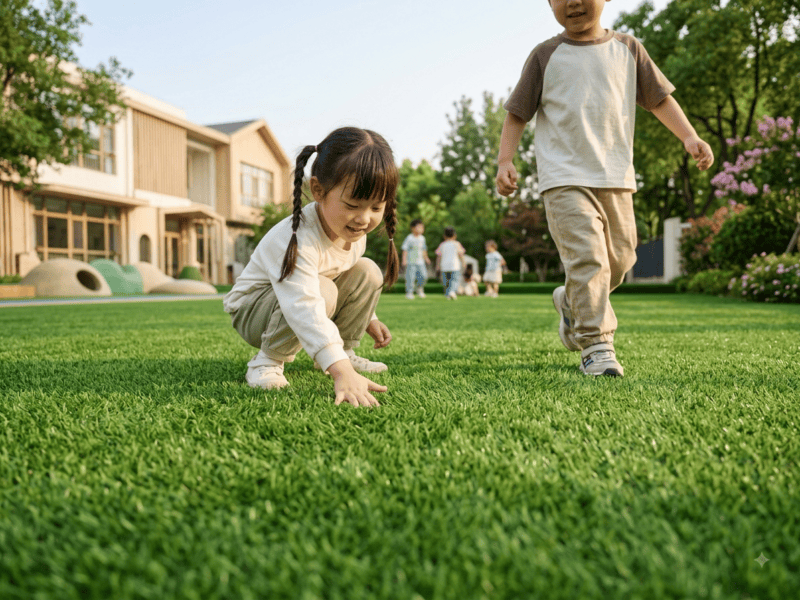
- Playgrounds & Childcare Facilities: Mandates maximum surface softness and shock absorption. Recommended spec: 100% Virgin PE yarn paired with dual-layer PP+Fleece primary backing and flexible PU coating to safeguard young users.
- Sports Pitches (Soccer & Rugby): Requires a balanced hybrid approach. High-density PE combined with resilient PP thatch yarns ensures true ball roll, cleats traction, and slide safety without premature matting.
- Residential Lawns & Commercial Landscapes: Demands high visual fidelity and comfortable barefoot feel. Multi-shape PE fibers featuring soft matte finishes deliver natural aesthetic integration.
Direct Factory Advantage: B2B OEM & ODM Solutions
As a specialized artificial grass manufacturer, we control raw polymer blending, yarn extrusion, precision tufting, and custom PU backing application under one roof. We partner with global distributors, landscape architects, and commercial contractors to supply engineered turf solutions tailored to specific climate conditions and performance requirements. Contact our technical engineering team today for factory samples and OEM inquiries.