
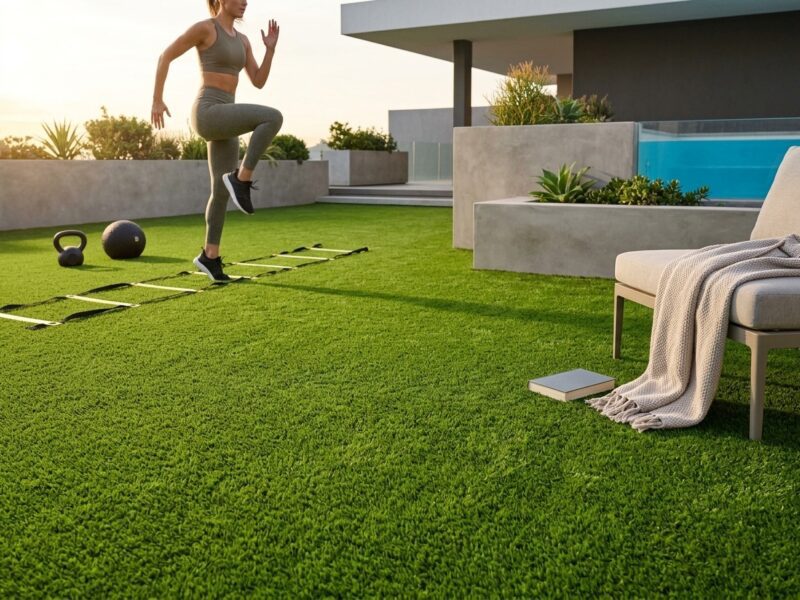
When most people think about choosing artificial grass, the first things that come to mind are usually visual: “How vibrant is the green?” or “Does it look like a manicured natural lawn?”
But if you’re designing a space where life actually happens—whether that’s a dedicated indoor functional fitness zone, a commercial gym area, or a high-traffic backyard where your family transitions from lounging to high-intensity workouts—there is a hidden metric that matters far more than aesthetics.
It’s called resilience.
As a specialized manufacturer of premium Leisure Artificial Grass, we’ve seen firsthand how a turf’s ability to “bounce back” marks the line between an investment that lasts for years and a flattened, worn-out surface that requires early replacement.
If you are trying to accommodate everything from daily leisure to intense HIIT (High-Intensity Interval Training) and strength work, here is exactly why resilience should be at the top of your checklist.
What Exactly is Turf Resilience?
In the artificial turf industry, resilience refers to the fiber’s capacity to recover its original upright position immediately after being compressed by external forces. Think about the sudden impact of a box jump, the heavy dragging of a weight sled, or even just the continuous foot traffic of a busy afternoon.
High-quality turf built for versatile leisure and fitness applications boasts a recovery rate of over 85%. When you step on it or press it down with your hand, it snaps back instantly.
This creates a dual advantage: it feels soft enough to cushion a fall during a burpee or a yoga stretch, yet firm enough to provide a stable, non-slip foundation for explosive movements.
Why Your Joints Care About the “Snap Back”
If you’ve ever tried doing a high-intensity workout on a hard, unforgiving surface like bare concrete or cheap, thin mats, your knees and ankles probably paid the price.
When turf has superior resilience, it acts as a built-in shock absorber. Here is how it protects your body:
- Impact Dispersion: Every time your foot hits the ground during sprints or plyometrics, the resilient fibers compress to absorb a portion of that energy, reducing the load transferred to your ankles, knees, and lower back.
- Preventing the “Sinking” Feeling: Poorly made turf flattens instantly and stays flat, leaving you feeling like you are “stepping into a hole.” Highly resilient turf offers uniform, springy support, helping you maintain proper posture and power transmission during strength training.
- Longevity Under Pressure: Heavy gym gear, kettlebells, or patio furniture can leave permanent dents on low-grade grass. High-resilience fibers resist matting, ensuring the zone remains safe, level, and visually pristine.
The Manufacturer’s Blueprint: What Makes Grass Resilient?
True resilience isn’t accidental. It is engineered from the ground up. When we manufacture top-tier leisure and multi-sport grass, we focus on three core technical elements:
1. 100% Virgin Materials (PE vs. PP)
The raw material makes or breaks the turf. Cheap turf often relies heavily on recycled plastics or brittle Polypropylene (PP). We utilize 100% virgin Polyethylene (PE). Virgin PE is inherently flexible, ductile, and tough, allowing the individual grass blades to bend without snapping or losing their structural memory.
2. High Density and Optimal Thickness
A sparse lawn cannot support heavy activity. For surfaces meant to withstand a mix of leisure and active training, the blade thickness should ideally be at least 1.2mm, with a tuft density of 8,000 clusters per square meter or higher. This dense structural network allows the blades to lean on and support one another, multiplying the overall bounce-back effect.
3. Advanced Weaving and Fiber Texturing (The KDK Secret)
Standard straight grass blades can easily mat down under directional pressure. To solve this, advanced manufacturing uses specialized texturing methods like KDK (Crimp/Curled Yarn) processing. This curls the fibers into tiny, interconnected omnidirectional micro-springs. Because the fibers are curled in multiple directions, they offer uniform support and rebound no matter what angle you push off from.
The Simple 3-Step Test for Quality Turf
If you are sourcing artificial grass for a project, you don’t need a laboratory to spot a high-performing product. You can run a quick check yourself:
- The Palm Press: Take a sample and press your palm firmly into the pile for 5 seconds. Release it. A high-resilience turf will instantly erase your handprint. If it leaves a noticeable crater, move on.
- The Footwear Feel: Lay the sample on a hard floor and step on it barefoot or with training shoes. Look for a balance: it shouldn’t feel like rock, but it shouldn’t feel like soft mud either. You want a crisp, energetic pushback.
- The Backing Inspection: Turn the turf over. High-performance turf requires a robust, multi-layer backing (usually reinforced with polyurethane or high-grade latex) to lock the fibers in place. If the backing feels flimsy or tears easily, the fibers won’t hold their resilience for long.
Elevating the Standard for Versatile Living Spaces
As fitness and leisure spaces become more integrated—with homeowners and commercial developers demanding areas that look beautiful but perform like professional athletic grounds—the quality of your artificial grass matters more than ever.
By prioritizing fiber resilience, you aren’t just buying a green carpet; you are investing in a durable, protective, and high-performance surface that looks immaculate on day one and remains just as supportive years down the road.
Looking to upgrade your space with premium, high-density Leisure and Functional Artificial Grass? Contact our team today to request samples engineered for ultimate durability and performance.