
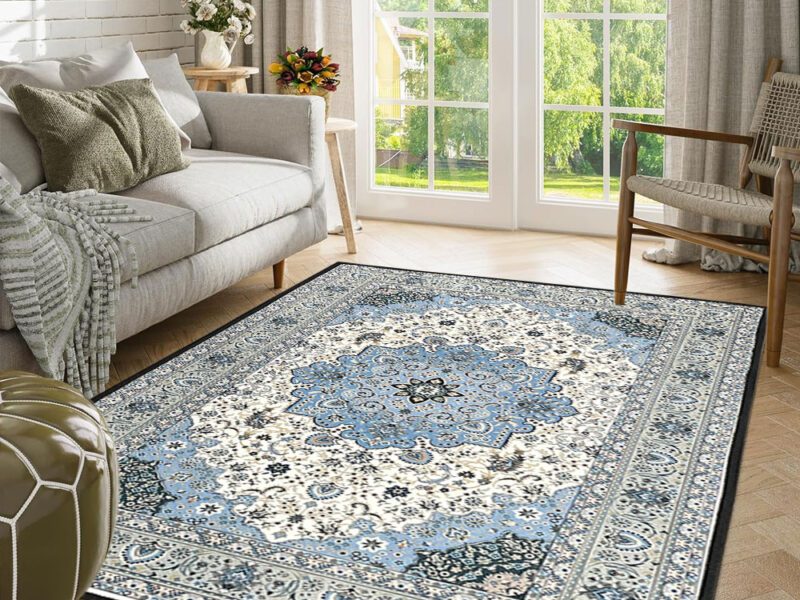
As a dedicated manufacturer of authentic Persian Rugs, we believe the true value of our creations lies in the journey—a time-honored process that transforms simple wool and silk into an unparalleled piece of art for your floor.
Have you ever wondered what gives a Persian rug that distinctive, luxurious softness—a feeling often described as “floating on air”? The secret is not just in the materials, but in an intricate nine-step process, perfected over centuries.
Here is a deep dive into the painstaking artistry behind every magnificent Persian carpet.
1. The Blueprint: Setting the Artistic Vision
Every great Persian rug begins with an intentional design, yet the path diverges based on its origin:
- Nomadic Charm: For rugs woven by nomadic tribes, the weaver typically works without a blueprint, relying purely on instinct and tradition. This freedom results in a truly one-of-a-kind, rustic charm.
- Urban Sophistication: To achieve complex, elaborate designs, professional designers create a meticulous “toile” (sketch) on graph paper. Each square represents a single knot, with colors and patterns precisely defined. This blueprint ensures the flawless execution of the most intricate motifs.
This preliminary design process dictates the rug’s ultimate artistic character and spirit.
2. The Alchemy of Color: The Dyeing Process
The rich, enduring colors of a Persian rug are born in the dye pot.
- Preparation: The wool or silk yarn is first thoroughly washed to remove oils and impurities.
- Dyeing: The cleaned yarn is dipped into dyes, sourced from natural ingredients (plants, insects) or high-quality chemical dyes. Master dyers, relying on years of experience, intuitively judge the precise temperature, immersion time, and use of mordants (fixatives) to achieve beautiful, lasting hues. A hallmark of natural dyes is their unique ability to deepen and mature over time, lending the rug an aged patina.
- Washing (Soaping): The final wash removes excess dye, setting the colors firmly.
Only yarn that has survived this rigorous dyeing process is deemed worthy of becoming a durable and beautifully colored Persian rug.
3. Laying the Foundation: The Loom and Warps
Before knotting begins, the loom is prepared. The warps (vertical threads) are strung onto the loom. These warps will later form the rug’s distinctive fringes. This seemingly simple setup is critical: it stabilizes the rug’s overall shape and prevents edge fraying, providing the rock-solid foundation necessary for the pile.
4. The Heart of the Rug: Hand Knotting
This is the most defining feature of a Persian rug—the hand knotting that creates the soft, dense pile (the surface fluff).
- Tying the Knots: Using the traditional Persian or Turkish knot method, each single pile thread is individually and manually tied onto the warps.
- Securing the Knot: After the knot is tied, the excess thread is cut with a knife, the weft (horizontal threads) are passed through, and a heavy comb is used to firmly beat the wefts down, locking the newly tied knots into place.
This meticulous, repetitive action is executed hundreds of thousands, sometimes millions, of times until countless pile threads stand tightly packed and upright on the rug’s surface.
The Secret to the “Floating Feel”: This dense, upright pile structure is the true key to the rug’s comfort. The tips of millions of tightly packed fibers act like a dense brush or a soft cushion, supporting and distributing your body weight across your entire sole. The elasticity of each fiber gently cradles your foot from below—the essence of that unique, luxurious sensation often called the “floating feeling.”
5. Releasing the Fabric: Taking it Off the Loom
Months, or even years, of weaving culminates in this critical, delicate process known as “unmounting.”
- Completing the Weave (The Kilim): Once the main pile is knotted, the warps are not immediately cut. A few centimeters of flat-woven, knot-less fabric (the “kilim”) are woven at the top and bottom edges, securing the pile and preventing the fringes from unraveling.
- Edge Reinforcement: The edges of the kilim section are secured with a strong stitch (like a chain stitch) to firmly lock the entire structure.
- Cutting the Warps: Only after all preparation is complete are the warps cut from the loom using specialized tools. The cut threads at the top and bottom now become the rug’s fringes.
At this stage, the rug is not yet a finished product. Its pile is uneven, and it is covered in weaving debris.
6. The First Magical Trim: The Shearing Process
After drying and meticulous shape adjustment (often involving steaming and stretching to the millimeter), the first moment of magic occurs: shearing.
Like an expert barber, a skilled artisan uses special fan-shaped blades and specialized machinery to trim the pile to a beautiful, uniform height. This process is where the weaver’s raw work is truly refined:
- Pattern Clarity: By ensuring every fiber is the exact same height, the slightly blurred outlines of the design suddenly snap into crisp, vivid focus.
- Unleashing the Luster: A uniform surface perfectly reflects light. This allows the natural sheen of the wool or silk to truly blossom, creating the renowned color-and-light play that shifts as you move around the rug.
This extra step elevates the Persian rug from a mere textile to a true work of art.
7. The Rejuvenating Cleanse: The Washing Process
Post-shearing, the rug enters the washing stage—a step that holds centuries of Persian wisdom.
Using generous amounts of water, natural soaps, and large brushes, skilled artisans boldly yet carefully scrub the entire rug.
- Deep Cleansing: This wash removes unseen dirt, fine fiber dust from shearing, and any residual dye, making the rug colors brighter and the rug itself more hygienic.
- Enhanced Softness: The fibers relax and bloom to the perfect degree, making the rug even more supple and fluffy.
- Stabilization: As the rug absorbs water and dries, the weave tightens, enhancing the rug’s overall stability and durability.
The final rinse involves a large, hoe-like squeegee, used to expertly push water out of the pile, one section at a time. Then, the rug is dried under the generous sun.
The Secret of Qom Water: For silk rugs, in particular, the local water quality is a closely guarded secret. Qom, a holy city in Central Iran, is said to have water containing trace minerals and the perfect amount of salt. This unique chemical balance gently nourishes the silk fibers, lending the finished rug an unmatched, silky smoothness that cannot be replicated elsewhere. Even top-tier rugs from other regions are often sent to Qom for this final, specialized wash.
8. The Final Polish: Re-Shearing
After the rug is thoroughly dried, the artisans perform a final, meticulous round of trimming!
While the first trim set the general height, this second pass is an extremely fine adjustment, down to the millimeter, performed after the fibers have settled post-wash. Even the slightest unevenness would blur the pattern and compromise the touch.
This step is pure artistry, relying entirely on the weaver’s decades of “intuition” and “experience” and the acute sensitivity of their fingertips. It is the true finishing touch—the final, soul-infused shave that ensures the surface is flawlessly smooth and the pattern is as beautiful and vibrant as possible.
9. Lasting Security: Fringe and Edge Finishing
The final stage ensures the rug is as secure as it is beautiful.
- Fringe Treatment: The warp ends are meticulously secured, one by one, to prevent unraveling, forming the elegant fringes.
- Edge Reinforcement: The side edges are the most vulnerable to wear. Using strong thread, the edges are tightly wrapped around the warps multiple times. This prevents the rug from losing its shape and makes it robust enough to endure decades of use.
It is often said that in any great work of art, “the details determine the overall quality.” This is unequivocally true for the Persian rug. These carefully executed final steps not only make the rug aesthetically pleasing but also give it the “true quality” that guarantees durability for generations.
We invite you to experience the difference that this time-honored, dedicated process makes.