
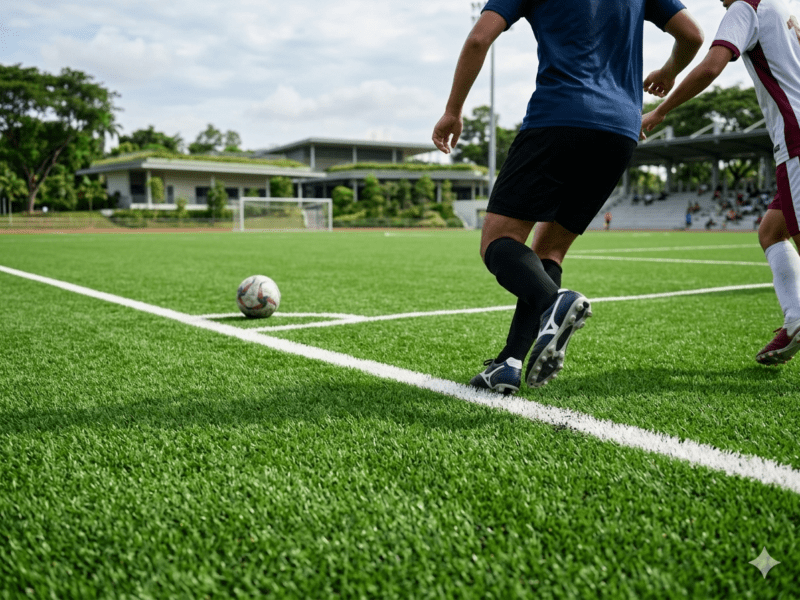
As urbanization accelerates, artificial turf has become a staple in modern landscapes. Thanks to its evergreen nature and low-maintenance appeal, it is widely installed across sports stadiums, public green zones, and residential courtyards. However, when evaluating the quality of synthetic grass, one critical metric stands above the rest: wear resistance. This factor single-handedly dictates the turf’s lifespan, user experience, and overall economic return. It is the ultimate benchmark that separates premium turf from substandard products.
The Core Science: What Determines Wear Resistance?
The ability of artificial grass to withstand continuous friction, crushing, and tearing without degrading isn’t accidental. It relies heavily on three interconnected technical factors:
1. Yarn Material (The Baseline)
The polymer composite used to extrude the grass fibers determines its foundational durability.
- Nylon (Polyamide / PA): The gold standard for wear resistance. It features exceptional resilience, making it perfect for high-frequency, high-impact environments like professional soccer fields.
- Polyethylene (PE): The ideal balance between cost-effectiveness and durability. Offering a softer texture and highly realistic look, it is the top choice for landscape turf and recreational spaces.
- Polypropylene (PP): This material has weaker wear resistance and is relatively brittle. It is generally reserved for low-intensity, short-term decorative applications.
2. Structural Design and Density
How the turf is engineered matters just as much as the raw material.
- Monofilament vs. Fibrillated: Monofilament grass blades inherently resist splitting and surface wear much better than fibrillated (split-film) alternatives.
- Texturing & Twisting: Incorporating texturized or twisted yarn processes significantly boosts fiber toughness.
- Tuft Density: A high-density tufting configuration—specifically ≥ 16,000 stitches per square meter—effectively disperses localized pressure, preventing premature matting and excessive wear.
3. The Infill System
Infill serves as the protective backbone of the turf system. While rubber granules provide a cushioning effect to absorb impact, silica sand delivers necessary structural stability. This system must be perfectly calibrated; an improper infill match can actually create abrasive friction, speeding up fiber degradation instead of preventing it.
The Common Enemies: What Causes Turf to Wear Out?
In real-world environments, artificial turf faces a non-stop combination of physical and environmental challenges:
- Mechanical Friction: Intense foot traffic, running shoes, and athletic cleats scrape and flex the grass blades constantly. This mechanical stress causes low-quality fibers to bend permanently, crack, or snap.
- Environmental Aging: Intense ultraviolet (UV) radiation is highly destructive to polymers, causing untreated grass blades to become brittle and crumble. Extreme shifts in temperature and humidity further accelerate material fatigue.
- Chemical Corrosion: External elements like acid rain, aggressive cleaning chemicals, or winter de-icing agents slowly erode the surface of the blades, weakening their internal structure.
A Manufacturer’s Guide to Maximizing Turf Lifespan
To ensure your synthetic turf maintains its pristine look and performance for years to come, a dual approach combining smart sourcing with proactive maintenance is essential.
Smart Sourcing at the Factory Level
When purchasing, prioritize high-density PE or Nylon fibers that feature built-in, premium anti-UV additives. Pay close attention to technical specifications such as the Dtex value (the linear density and thickness of the yarn) and tuft bind strength (how securely the fibers are anchored into the backing).
Flawless Installation & Maintenance
- Sub-base Preparation: Ensure the ground foundation is completely flat and has excellent drainage capacity. This prevents uneven base settlement, which creates high-friction hot spots where the turf wears down rapidly.
- Routine Grooming: Regularly brush or comb the grass fibers against the nap to keep them standing upright.
- Infill Management: Replenish and distribute infill granules uniformly across the field to shield the lower sections of the grass blades from direct physical damage. Additionally, avoid scratching the surface with sharp objects and try to rotate usage across exceptionally high-traffic zones.
Long-Term Value and the Future of Turf
Today, evaluating wear resistance is no longer a matter of guesswork. Standardized testing frameworks, such as the Martindale wear test and accelerated UV aging tests, provide definitive, scientific proof of product quality.
Investing in high-wear-resistant artificial turf pays off by drastically lowering replacement frequencies and slicing ongoing operational budgets, all while maintaining a flawless, safe, and practical aesthetic. As polymer technology continues to advance, our manufacturing focus remains on engineering even tougher, more eco-friendly artificial turf solutions—delivering sustainable, resilient green spaces built to last.