
As a leading manufacturer of wall-to-wall carpets and mats, we’ve seen carpets transition from a simple floor covering to a fundamental element of modern interior design. Whether you’re an interior designer, a facility manager tasked with a corporate office overhaul, or a homeowner looking for a luxurious touch, understanding carpet specifications and, crucially, how to calculate installation loss, is essential.
This guide breaks down the basics to help you plan your next project efficiently and cost-effectively.
📐 Carpet Types and Standard Specifications
Carpets are primarily categorized by their application and format, which directly influences installation and material efficiency.
1. Broadloom Wall-to-Wall Carpet
Broadloom is the classic choice for a seamless, luxurious look, typically used for large areas like offices, hotels, and homes.
- Standard Widths: The most common width for broadloom carpet is 4 meters. Less common, but still available, are widths of 3.66 meters (approximately 12 feet).
- Roll Lengths: Rolls usually come in lengths of around 25 meters.
- Installation Loss (Waste): For broadloom, the installation loss is higher due to the need for seaming and pattern matching.
- Standard Rooms (Regular Shape): Installation loss is typically in the range of 5% to 12%.
- Irregular or Odd-Shaped Rooms: For areas with many angles, columns, or curves (often referred to as ‘odd-shaped rooms’), the loss must be calculated on a case-by-case basis and can be significantly higher.
2. Carpet Tiles (Modular Carpet)
Carpet tiles offer flexibility, ease of replacement, and reduced waste, making them extremely popular for commercial settings.
- Common Sizes: The most frequently used size is 500 mm x 500 mm (50cm x 50cm). Other sizes include 600 mm x 600 mm and 900 mm x 900 mm.
- Installation Loss (Waste): Due to their small, modular size and ability to be rotated, carpet tiles have a much lower loss rate.
- Typical Loss: Installation loss generally ranges from 3% to 8%.
🧮 The Critical Calculation: Understanding Installation Loss (Waste)
One of the most common mistakes in carpet purchasing is equating the Installation Area with the Material Purchase Quantity. As a manufacturer, we must account for this loss in production.
Key Concept: Installation Area vs. Material Area
Installation Area is the actual size of the room (e.g., 50 sq. meters).
Material Area is the total square footage of carpet you must purchase, which includes the necessary waste/loss for cutting and fitting.
The “Why” of Broadloom Loss
Broadloom loss is primarily driven by:
- Fixed Width: Since the roll is a fixed width (e.g., 4m), any room width that doesn’t fit a multiple of 4m will result in significant offcuts.
- Example from your content: A room is 3.6m wide and 5m long (Total Area: 18 sq. meters). Since you must purchase a 4m wide roll, you need a piece that is 4m x 5m (Total Purchase: 20 sq. meters).

- Pattern Repeat: For patterned carpet, pieces must be cut so the design lines up perfectly at the seams. This often requires cutting off a length equal to the pattern repeat, greatly increasing waste, especially in long corridors or multiple rooms.
Industry Standards for Broadloom Installation Loss
While actual loss depends on the specific room layout and pattern repeat, common industry allowances are:
| Application Area | Typical Loss Percentage | Reason |
| Hotel Guest Rooms | 10% | Relatively standard sizes, minor pattern matching. |
| Corridors/Hallways | 12% | Long, fixed width, high pattern repeat demand. |
| Public Areas (Ballrooms, Restaurants) | 15% – 20% | Often have very large pattern repeats, columns, and irregular shapes. |
Real-World Example: Calculating Hotel Corridor Carpet
Let’s use the example provided in your content:
- Actual Installation Area (Corridor): 2,000 sq. meters
- Required Loss Allowance (Industry Standard): 12%
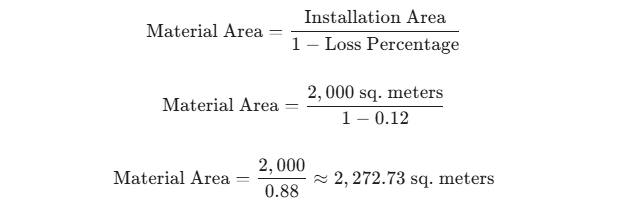
Therefore, for a project with an installation area of 2,000 sq. meters and a 12% loss factor, you would need to order approximately 2,273 sq. meters of carpet.
By understanding these specifications and the critical difference between installation area and material area, you can streamline your procurement process, minimize budget overruns, and ensure a flawless carpets installation.
Related reading: Carpet Pile, Density & Tufting: Specifier’s Guide